
.svg)
supply chain sustainability 2026
How companies are using AI to build more sustainable supply chains
Independent research by the MIT Sustainable Supply Chain Lab
Associate Sponsors:
.svg)
Key Takeaways
This year’s findings reinforce a key insight: companies have never been more committed to sustainability, and commitment is no longer what holds them back. What decides outcomes now is whether the measurement, governance and operating systems underneath that commitment are built to deliver on it.
Now in its seventh edition, the MIT State of Supply Chain Sustainability report captures responses from 1,810 supply chain, procurement, operations and sustainability professionals across 91 countries. CO2 AI, along with the support of Dassault Systèmes, is a proud associate sponsor of this year’s research.
1
Corporate commitment has never been higher, with 83% of companies calling sustainability important to long-term business success but 68% have delayed or compromised their sustainability strategy under tariff pressure.
2
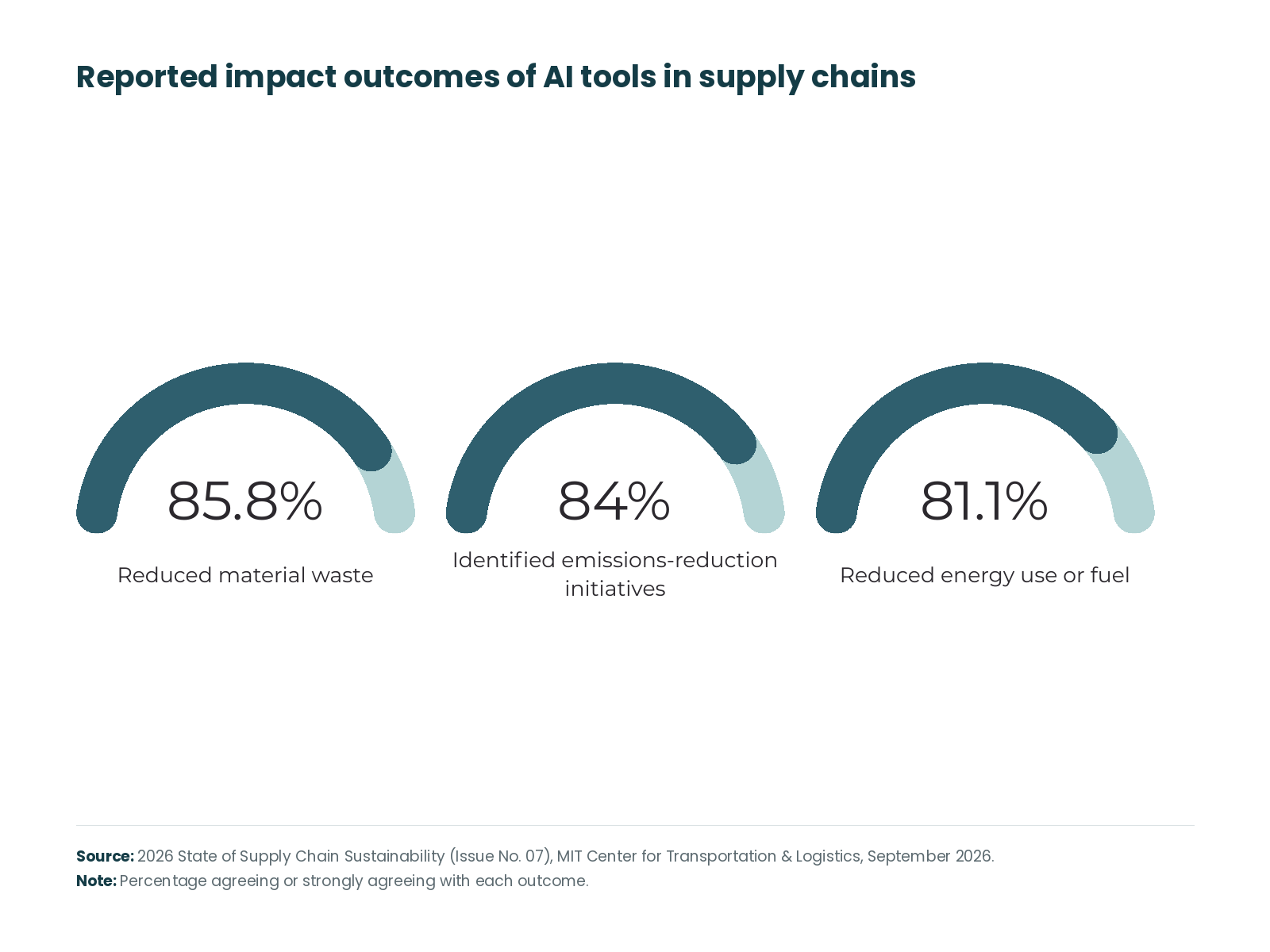
AI has moved from advising supply chains to running parts of them. 51% of companies describe their AI as partially or largely autonomous, and 86% of adopters report reduced material waste.
3
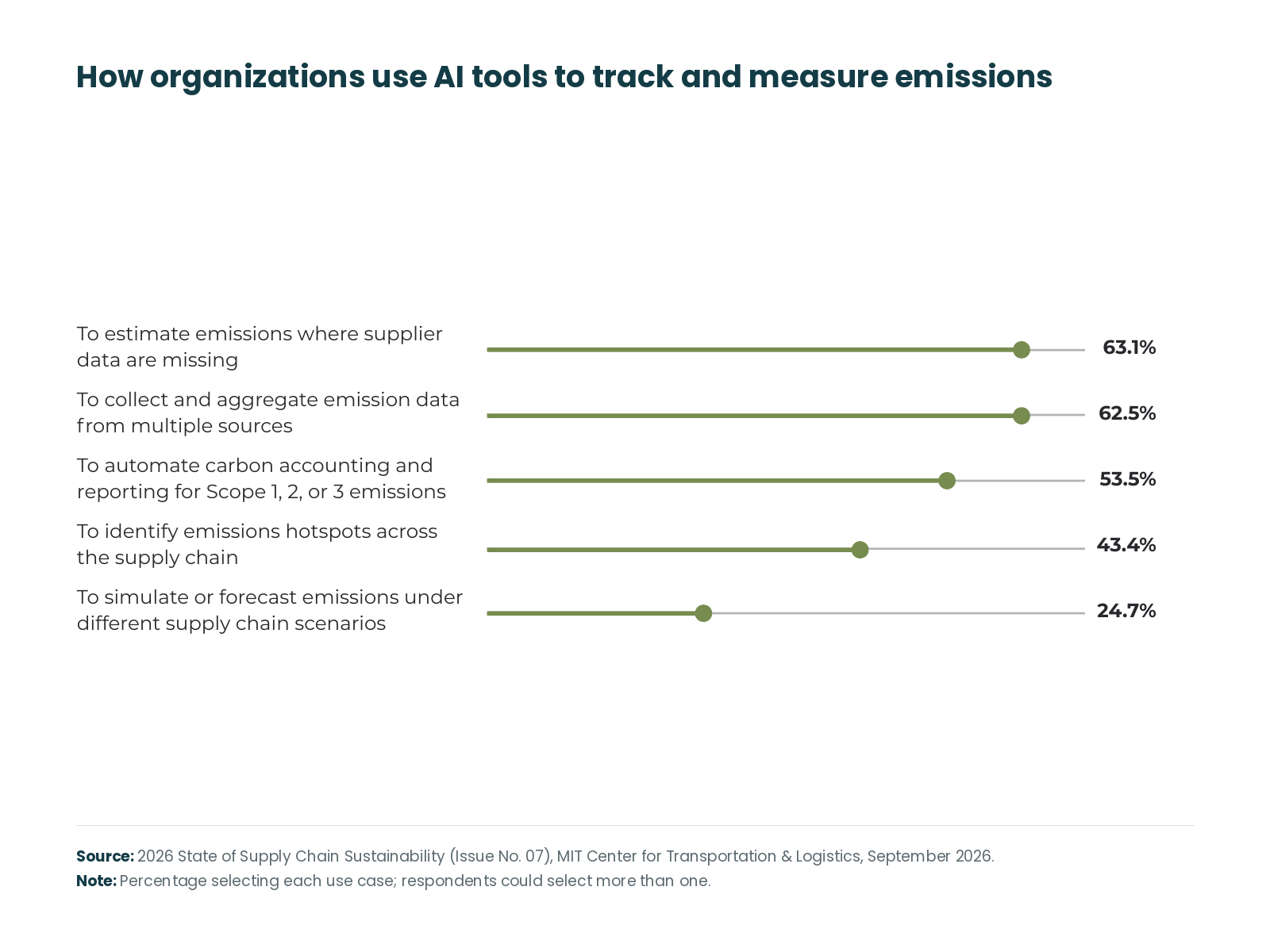
Converting commitment into accountability is the real challenge now. 63% of companies use AI to estimate emissions where supplier data are missing but only 25% use it for forward-looking scenario analysis. The strategic potential of AI largely remains untapped.
Sustainability Ambition Is Growing Under Greater Uncertainty
Corporate climate ambition is growing, despite major shifts in U.S. climate policy following President Trump’s re-election and the U.S. withdrawal from the Paris Agreement.
—
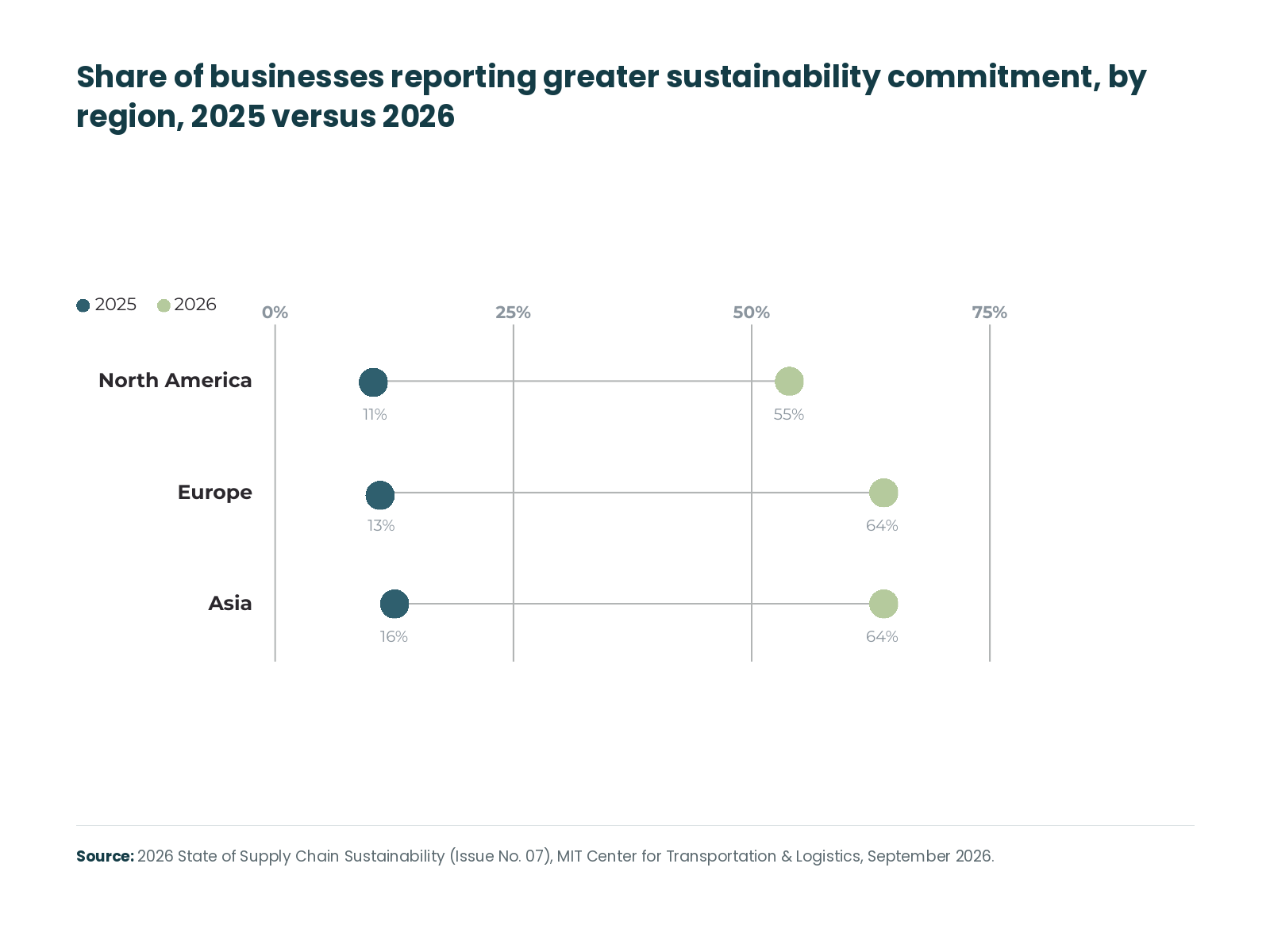
59% of companies became more committed to sustainability following recent US climate policy shifts, against only 13% that pulled back.
—
But 68% report that tariff uncertainty has forced them to delay, scale back or compromise their sustainability strategy.
—
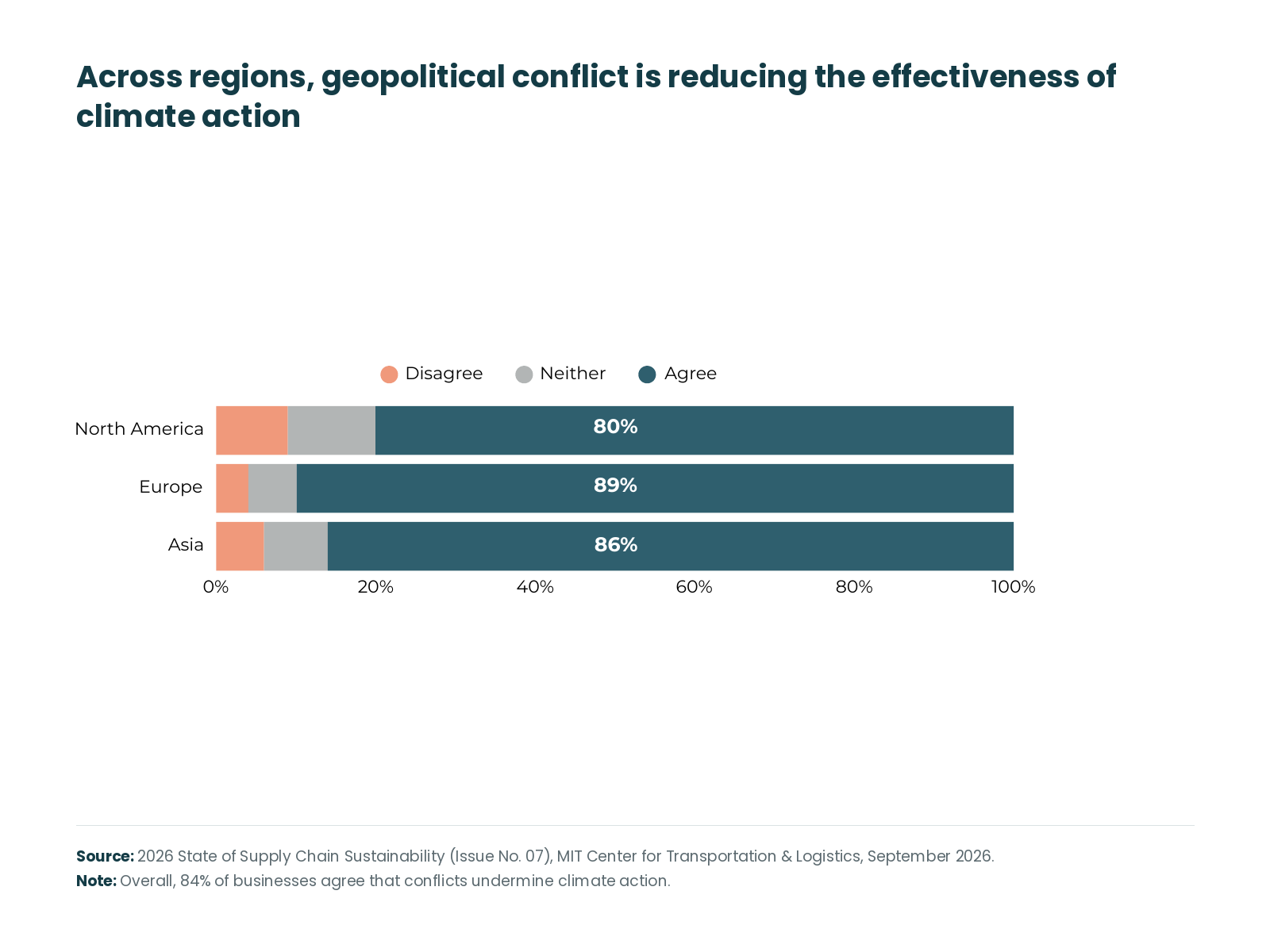
And 84% agree that ongoing geopolitical conflict is reducing the effectiveness of the climate action they are able to take.
While external uncertainty is making the operating environment challenging, the internal gaps are just as glaring. Corporate climate ambition is outrunning the governance built to support it.
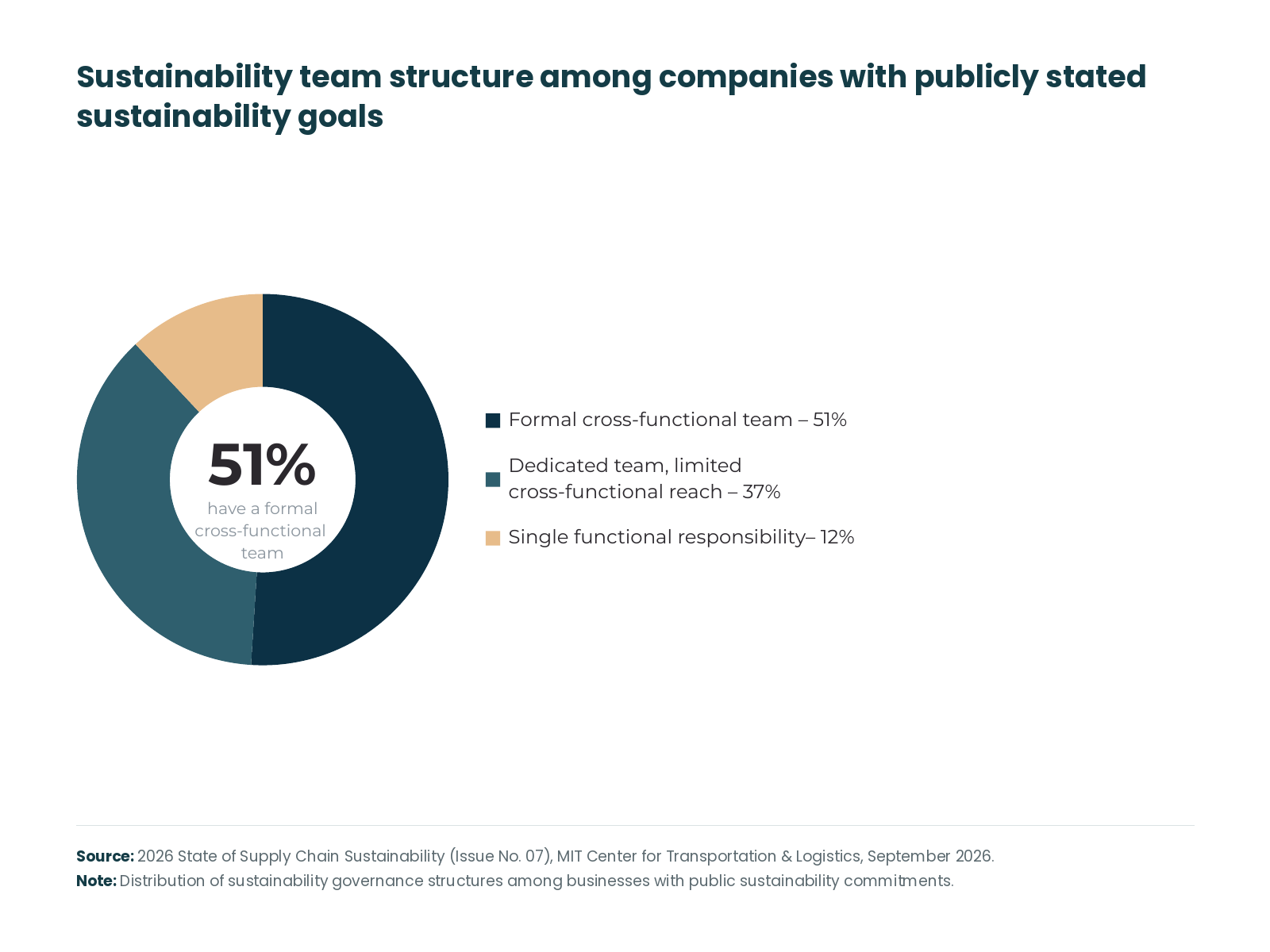
Only 51% of companies with public sustainability goals have a formal cross-functional team, and just 33% place oversight at board level.
Only 51% of companies with public sustainability goals have a formal cross-functional team, and just 33% place oversight at board level.


.svg)
About the Research
The MIT Sustainable Supply Chain Lab surveyed 1,810 professionals across 91 countries, spanning supply chain, procurement, operations, logistics and sustainability roles. Now in its seventh edition, the study examines how organisations are responding to geopolitical disruption, shifting policy, rapid advances in artificial intelligence, and the continuing challenge of decarbonising supply chains. CO2 AI is an associate sponsor of the 2026 report; the research, analysis and conclusions are MIT’s.
Sustainability Is Driving Operational Efficiency
Sustainability increasingly shapes the decisions companies make every day. It is explicitly weighed in transportation and logistics (39%), procurement and sourcing (35%), warehousing (34%) and product and packaging design (33%) — and thins out in capital investment, network design and risk planning, at roughly 23% each. In MIT’s reading, sustainability is showing up in operating considerations but not yet in the design principle.
—
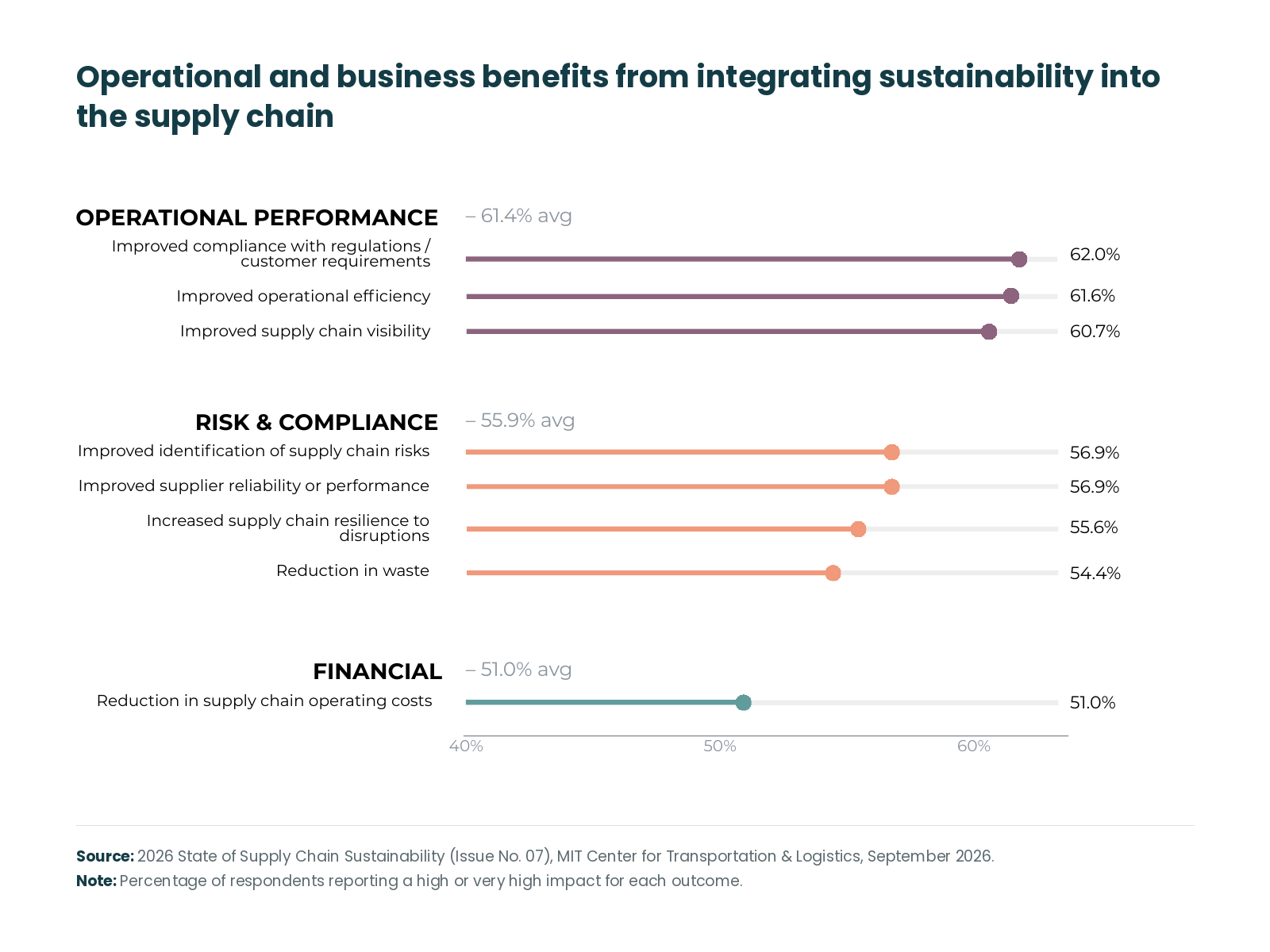
Build the business case around efficiency. The benefits companies report most often are improved compliance with regulation and customer requirements (62%), improved operational efficiency (62%) and better supply chain visibility (61%). These benefits all reach the P&L by helping lower operating costs and building resilience in the supply chain.
AI Is Moving Into the Operational Layer
The significant finding in this year’s data is that AI has moved into the operational layer of the supply chain — the buying, forecasting, scheduling and moving — and it is moving there fast enough to show up year on year. Two forms of it are advancing together:
—
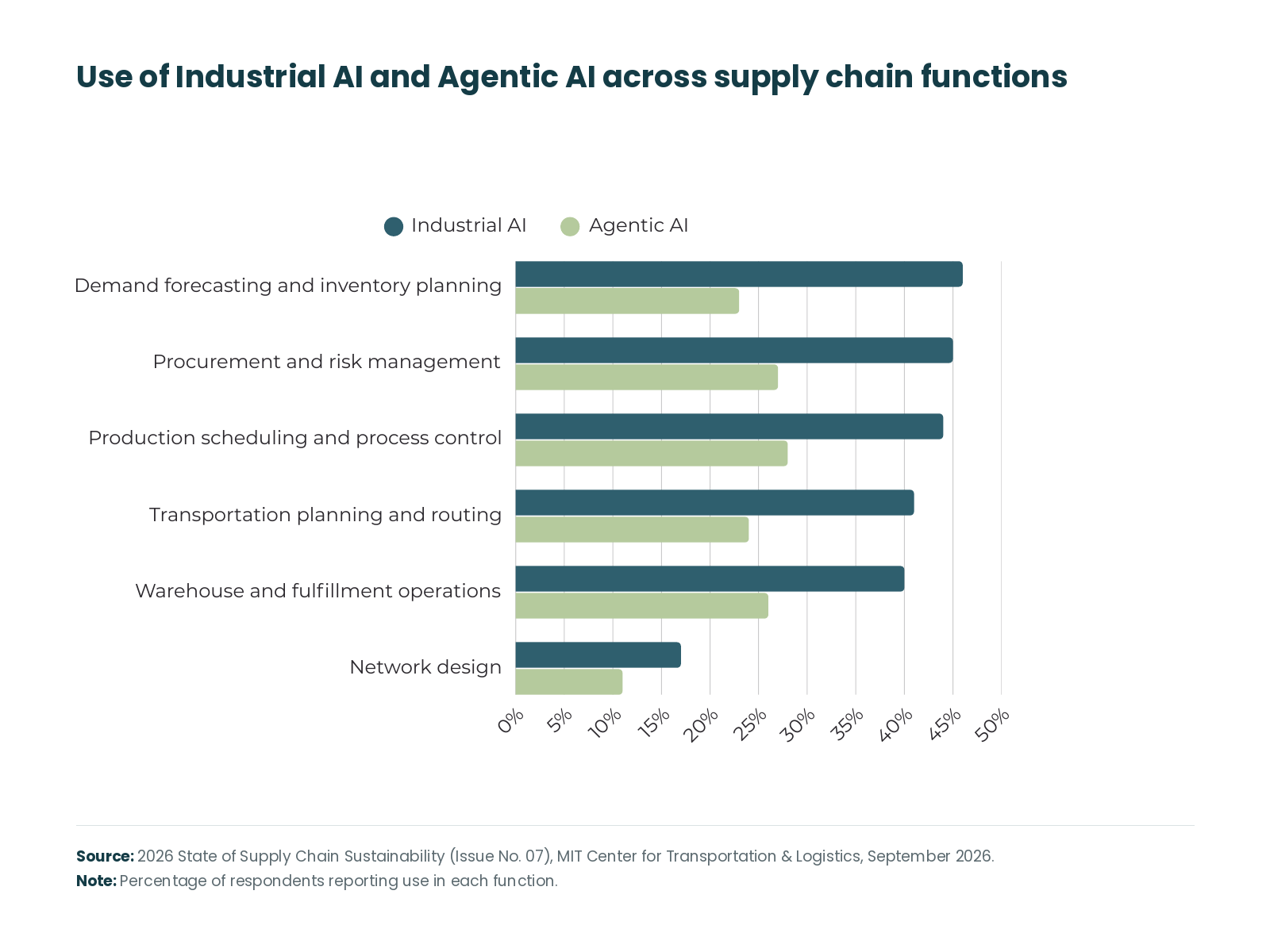
Industrial AI. The report describes Industrial AI as 'systems used to support prediction, optimization and decision making in operational or organizational processes.' 78% of North American, 77% of European and 76% of Asian companies are reporting it in sustainability work. Within the supply chain, adoption peaks where the work is structured and data-rich: demand forecasting and inventory planning (46%), procurement and risk management (45%), and production scheduling (44%).
—
Agentic AI. Described as 'systems that can autonomously or semi-autonomously make, adapt, and execute decisions to achieve goals with limited human intervention' , Agentic AI is increasingly being leveraged in more structured operational areas. Among companies using it, only 5% are still piloting: half report broad use across multiple functions, and 19% describe it as integrated and autonomous across most of the organisation.
Overall, 51% of companies now describe their AI as partially or largely autonomous — 60% in Asia, 52% in Europe, 47% in North America, and near-identical between mid-size and large organisations. The warehouse is the leading indicator: 71% of AI-using warehouses report some degree of autonomy. The line between AI that recommends and AI that acts has already been crossed across most of the supply chain. The harder question is no longer which model to use, but how to apply it inside an operation that is already running — what we call Applied AI.
Companies Using AI Can Trust Their Emissions Data
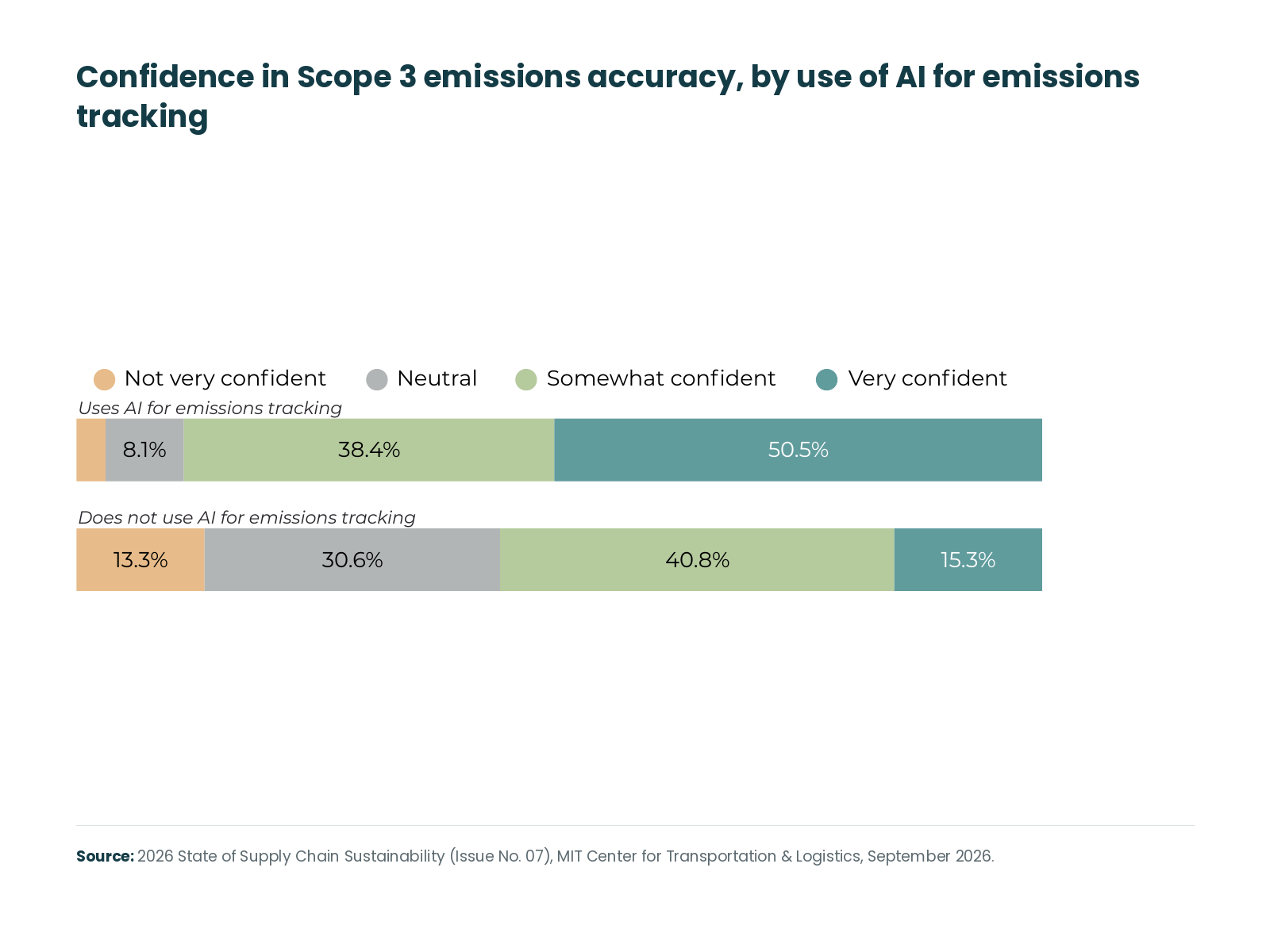
Companies are not using AI to decide their sustainability strategy but it is building trust in their own data. Half of those using AI for emissions tracking say they are very confident in the accuracy of their Scope 3 estimates, against 15% of those that do not. Asked what they actually use AI for on emissions, companies point to four jobs:
1
Estimating emissions where supplier data is missing (63%)
2
Collecting and aggregating emissions data from scattered sources (63%)
3
Automating carbon accounting and reporting across Scopes 1, 2 and 3 (54%)
4
Simulating or forecasting emissions under different supply chain scenarios (25%)
Why Efficiency Gains Don’t Always Reduce Emissions
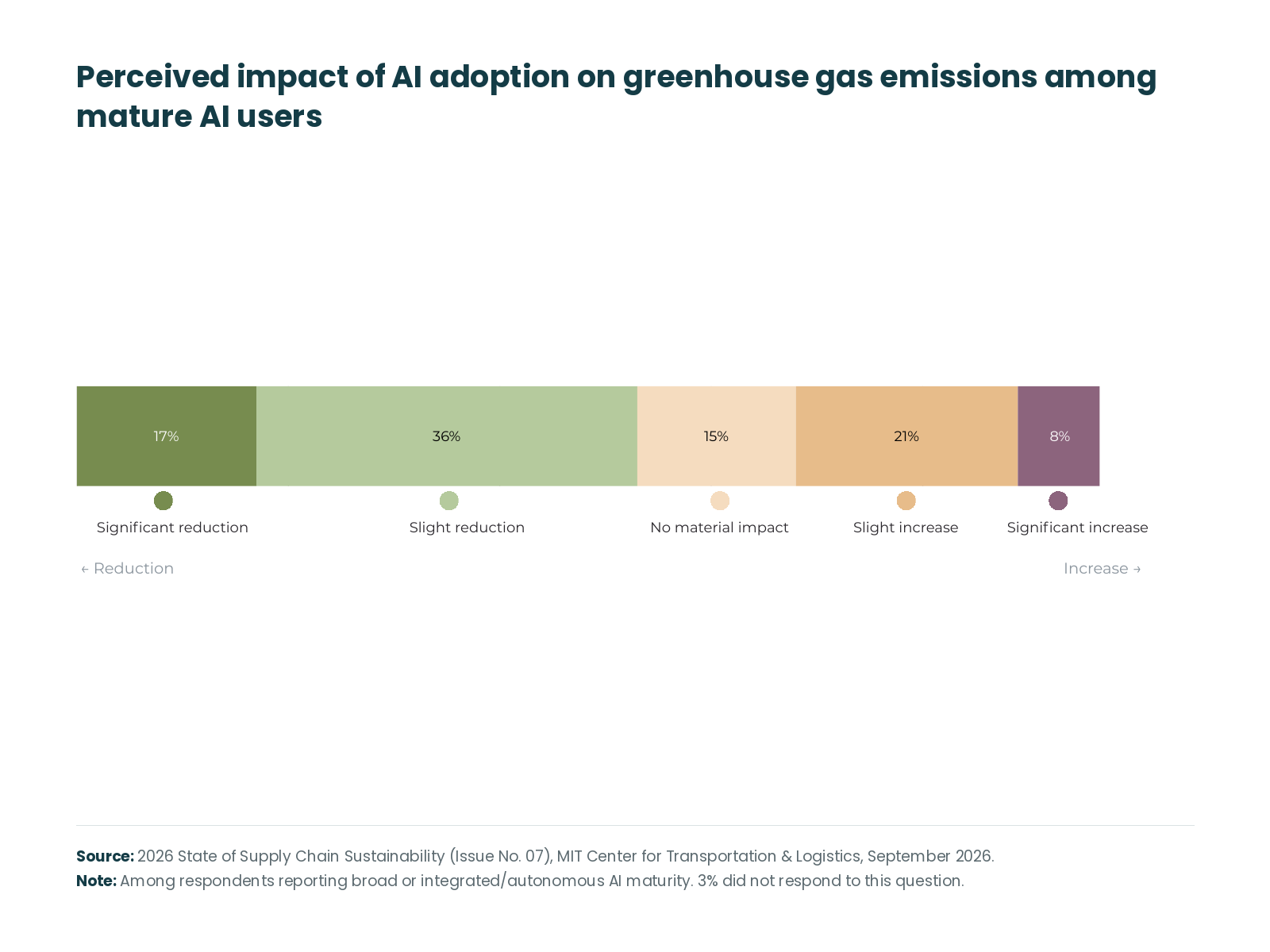
Among mature AI adopters, 53% report a reduction in total emissions, while 29% report an increase and 15% report no material change. AI is delivering on its promise: operations get leaner, faster and less wasteful, but it does not automatically lead to a lower total footprint. MIT is careful to note that the survey cannot separate the effect of AI from automation, throughput or growth — and neither can we.
The practical reading is that many companies are still reconciling AI-driven efficiency benefits into measurable net emissions reductions. The challenge now is to ensure that these efficiency gains ultimately translate into lower total emissions.
What Applied AI Means in Practice
The findings above describe one gap from four angles. AI is already operating inside the supply chain, the value it creates is real, and turning that operational gain into a measurable outcome is not automatic. That gap is the difference between adopting AI and applying it. Three conditions separate the two, and each comes directly out of the research.
“The next wave of enterprise AI won’t be won by better copilots, but by applying AI to the messy operational data and workflows that actually move the P&L across procurement, supply chain, operations and sustainability… That’s the promise of Applied AI. Thoughtfully deploying one operational transformation can deliver multiple positive business outcomes.” —
Charlotte Degot, CEO of CO2 AI, writing in the 2026 State of Supply Chain Sustainability
Charlotte Degot, CEO of CO2 AI, writing in the 2026 State of Supply Chain Sustainability
The first condition is to build for the data companies actually have. 75% still run emissions work on spreadsheets alongside dedicated carbon software, and 63% use AI to estimate emissions where supplier data is missing. Fragmented, imperfect data is the operating condition rather than a phase to get past, and anything that needs clean data first does not survive contact with an enterprise. The second is to put measurement inside the workflow rather than downstream of it. Only 24% of warehouses monitor in real time while their AI is deciding continuously — and when measurement sits outside the loop, the outcome cannot be verified.
The third is domain depth. Network design is the least automated function in the supply chain at 18%, and strategic prioritisation ranks last among the goals AI has helped with, at 27%. What is missing there is not model capability but knowing how the operation actually runs. Taken together, that is why a single operational transformation can move cost and carbon at once: the same procurement, inventory and logistics levers touch both. The report’s own finding that 84% of adopters identified emissions-reduction opportunities as a by-product of operational work is the clearest evidence that the two travel together.

Applied AI · Use case
Measure what your suppliers can’t yet report
An automotive OEM had no real figures for four fifths of what it bought — its suppliers simply couldn’t provide them. It now tracks nine in ten, modelling the gaps and swapping in supplier data as it lands.
Learn about the use case →
What Companies Can Do Now
1
Close the governance gap alongside the technology gap. Companies with a formal cross-functional team build sustainability into day-to-day decisions at 57%, against 13% where responsibility sits in a single function. Hard-wire sustainability accountability in your governance to see a real shift in outcomes.
2
Measure at the speed the AI decides. If systems are reallocating inventory hourly and emissions are reported annually, efficiency and footprint will drift apart unnoticed. Real-time monitoring is the difference between managing an outcome and discovering it a year later.
3
Point AI at the decisions sustainability has not reached. Network design, capital investment and supplier structure have long-term impact on your business and footprint and they are the least automated decisions in the supply chain. The operational wins are largely taken; the structural ones is where the real opportunity lies.
4
Start adopting technology and greenlighting projects, even if you feel that your data is not perfect. Build on the data you have. Treat fragmented, imperfect data as the operating condition rather than a prerequisite to fix first, or the project never starts.
The 2026 findings describe an agenda that has not lost momentum but has reached a harder stage. Commitment is strong, measurement is expanding, collaboration is deepening and AI is accelerating. What comes next is more difficult: converting commitment into accountability, operational integration into strategic decision-making, and efficiency into net environmental benefit.
