.svg)
Product Carbon Fooprint
Compute, review, and share PCFs faster than ever

Know the Carbon Footprint of Every Product You Make
CO2 AI makes Product Carbon Footprint computation fast, accurate, and scalable, so you can turn carbon data into a competitive advantage.
PCF Computation Is Broken. Here Is Why.
Most companies still calculate Product Carbon Footprints manually, in spreadsheets, disconnected from their actual product data. The result: months of work, unreliable numbers, and carbon insights that come too late to drive real decisions.
Three root causes make PCF hard at scale:

The companies that will win on sustainability are those that make carbon data as accessible as cost or performance data. CO2 AI is built for exactly that.
CO2 AI brings all your product carbon data into a single, automated system - turning raw inputs into certified, shareable footprints. No manual work. No trust gaps.
Import your product data from any source: Bills of Materials, energy and utility records, waste streams, transportation... Upload via flat files, bulk import, or API integration.

CO2 AI automatically cleans your data, applies the right emission factors using AI-powered matching, and runs its computation engine to calculate accurate PCFs.
Validate Emission Factors and footprint calculation results with a full audit trail. Every assumption, every data, every calculation step is traceable and transparent.
Share PCFs with customers and stakeholders in PACT and TfS compliant formats, via API, CSV, or PDF. Compute once, share as many times as you need.

Balance speed and control with AI-Assisted Calculation

Speed up your product footprints calculation, across thousands of SKUs at once.


Obtain compliant LCAs, with full traceability and auditability.
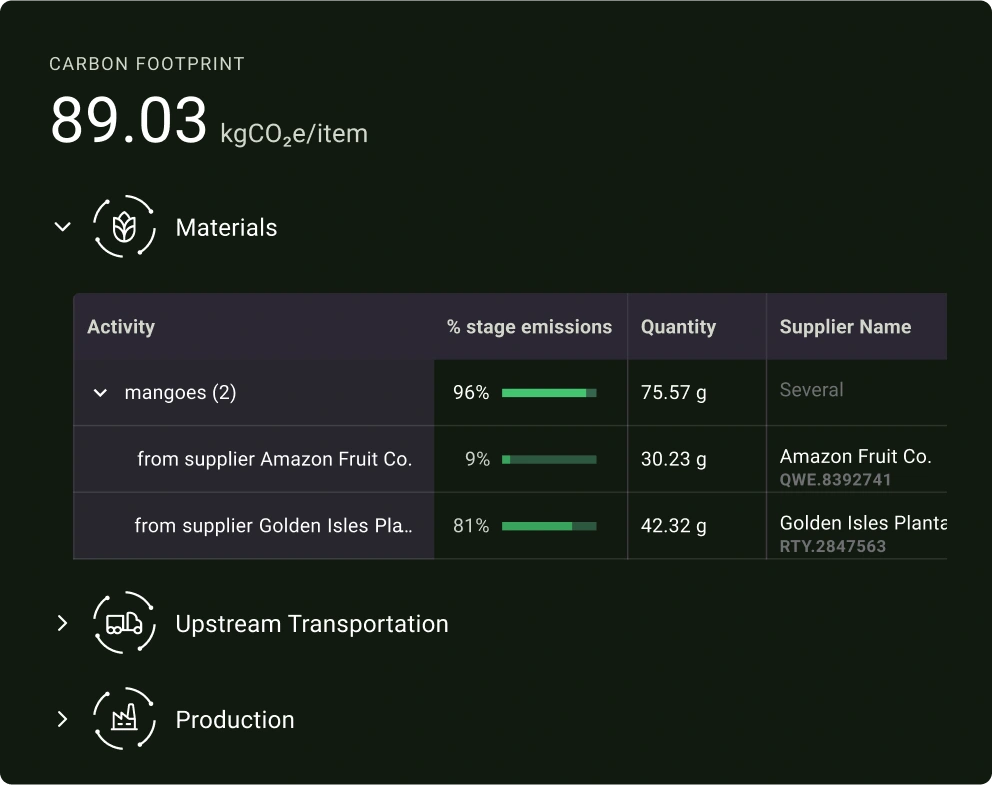

Easily share LCAs with customers to stand out from competition.


Unlock actionable decarbonization initiatives.

Comply with international standards


Industrializing product footprinting
CO2 AI is working to enable the company to scale impact measurement from a few products to thousands, aligning with key standards including PACT, Together for Sustainability, and PEF.
Providing transparent, reliable product data enables the company to protect its share of business with its largest customers, as well as to identify key areas for reduction across ingredients, materials, and processes. Product owners, buyers, R&D engineers, and sustainability teams work hand-in-hand to accelerate the journey to Net Zero and reinforce the company’s leadership in sustainability.
What is a Product Carbon Footprint (PCF)?
A Product Carbon Footprint measures the total greenhouse gas emissions generated across a product's lifecycle, from raw material extraction to manufacturing, transportation, and end of life. It is expressed in kg or tons of CO2 equivalent (CO2e) and is the standard metric used by customers, regulators, and sustainability frameworks like PACT and TfS.
Why do companies need to calculate PCFs?
Customer demand for PCF data is growing fast, driven by corporate decarbonization commitments, supplier qualification requirements, and incoming regulations. Companies that cannot provide verified PCFs risk losing contracts and falling behind competitors who can demonstrate measurable emissions reductions at the product level.
What data do I need to calculate a PCF?
CO2 AI can compute PCFs from four main data types: Bills of Materials (BOM), energy and utility consumption, waste data, and transportation records. You can upload this data via flat files, bulk import, or direct API integration with your ERP or PLM system.
How does CO2 AI calculate PCFs automatically?
CO2 AI combines three core capabilities: automated data cleaning and transformation, a computation engine that applies the right methodology to your product structure, and AI-powered emission factor matching that maps your inputs to the most relevant carbon factors. The result is a traceable, auditable PCF without manual work.
Is CO2 AI compliant with PACT and TfS standards?
Yes. CO2 AI is a PACT-conformant solution and maintains an active partnership with the Partnership for Carbon Transparency. This means the PCFs computed on CO2 AI meet the latest industry standards for methodology and data exchange, and the platform is updated automatically as those standards evolve.
Can I share PCFs directly with my customers?
Yes. CO2 AI includes a built-in PCF exchange system. You can share PCFs via API for IT integration and bulk requests, CSV for large-volume exchanges, or PDF for individual customer-facing documents. All formats are PACT and TfS compliant.
Can CO2 AI handle complex product structures?
Yes. CO2 AI is built for industrial complexity. It supports multi-level Bills of Materials, reused materials, shared components, and by-products. Every layer of your product structure is accounted for, with a complete audit trail for each calculation.
How is CO2 AI different from a standard carbon accounting tool?
Most carbon accounting tools are designed for corporate-level Scope 1, 2, and 3 reporting. CO2 AI is purpose-built for product-level carbon footprinting at scale, with direct integration into product development workflows. It is designed to be used by R&D and engineering teams, not just sustainability experts.
How long does it take to compute a PCF with CO2 AI?
Once your data is connected, PCFs can be computed in a fraction of the time it takes with manual methods. The exact timeline depends on your data readiness, but CO2 AI is designed to handle thousands of PCFs with the same setup.
Do my R&D teams need to be carbon experts to use CO2 AI?
No. CO2 AI is built specifically for teams who are not carbon specialists. The platform automates the most technical steps, including emission factor matching and methodology application, so product and engineering teams can access carbon insights without needing deep sustainability expertise.


Explore more resources

Read


Read

Read
.svg)

.svg)
